PRS#4 - WIP
Home Page

Project Outcome: Installation
JAN 2023
SEP 2023 - WIP
PRS ASIA
Lifted Motörway Project: Investigating the sonic atmosphere through experiential fieldwork in the jungle.
https://studentlab1.rmit.edu.vn/%7Ev81013/index4.html
Black Murmur: Installation Panorama:
The Lifted Motorway Panorama:
Massive
Dragonflies
Atmosphere #1
Project Audio Sample:
1.Vertical Recording OnGround: 1 April 2023 Two audio recorders are aligned verticaly under the elevated expressway while recording simultaneously, here is the first recording from the ground
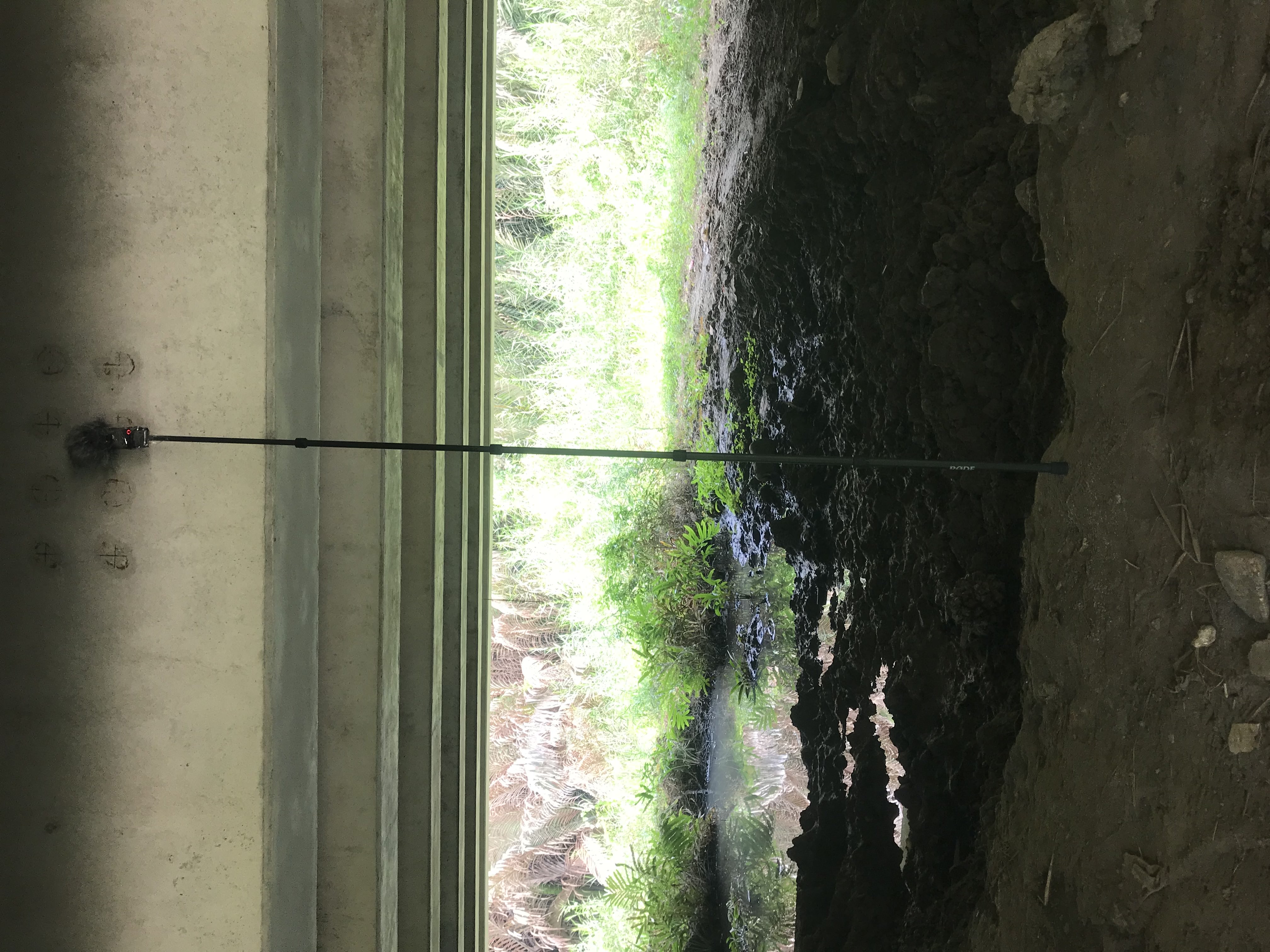
2.Vertical Recording OnBoomPole: 1 April 2023 Two audio recorders are aligned verticaly under the elevated expressway while recording simultaneously, here is the second recording from the boom pole
https://studentlab1.rmit.edu.vn/~v81013/index4.html
![]()
JAN 2023
SEP 2023 - WIP
PRS ASIA
︎
Lifted Motörway Project: Investigating the sonic atmosphere through experiential fieldwork in the jungle.
https://studentlab1.rmit.edu.vn/%7Ev81013/index4.html
Black Murmur: Installation Panorama:
The Lifted Motorway Panorama:
Massive
Dragonflies
Atmosphere #1
Project Audio Sample:
1.Vertical Recording OnGround: 1 April 2023 Two audio recorders are aligned verticaly under the elevated expressway while recording simultaneously, here is the first recording from the ground
2.Vertical Recording OnBoomPole: 1 April 2023 Two audio recorders are aligned verticaly under the elevated expressway while recording simultaneously, here is the second recording from the boom pole
https://studentlab1.rmit.edu.vn/~v81013/index4.html

PROJECT#4
The Lifted Motorway
Concept Finding: Thần [spirit of the land]
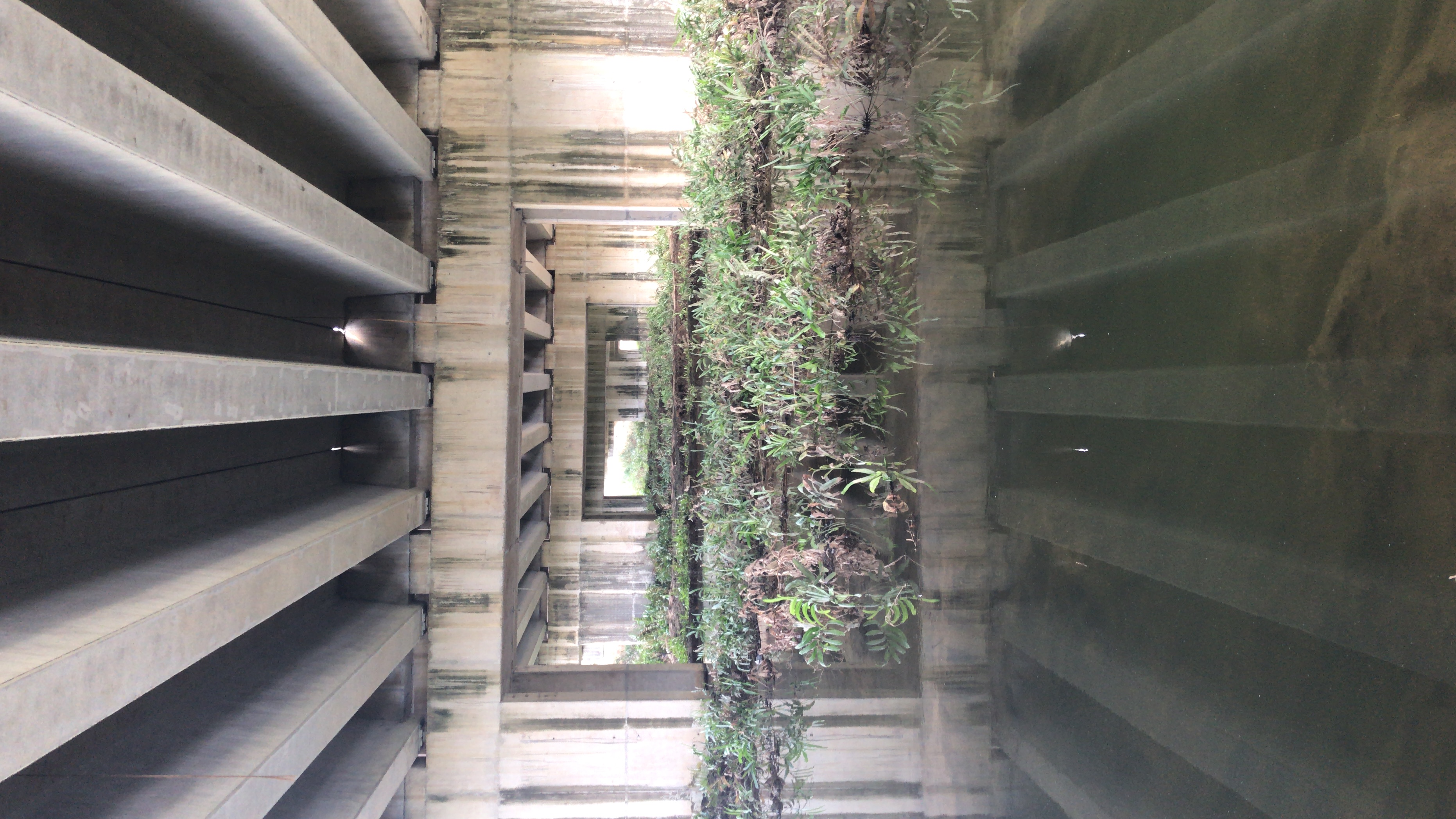
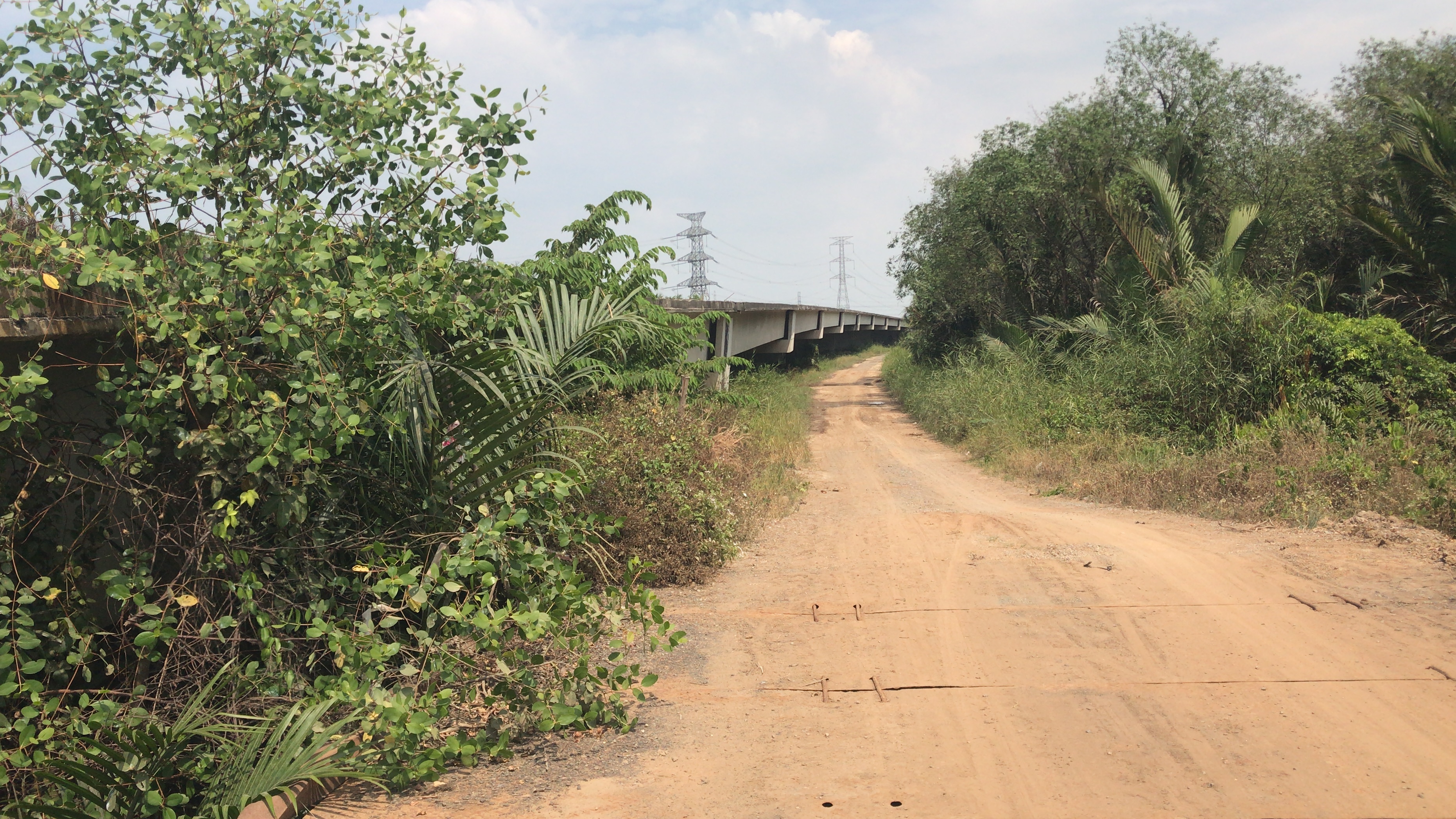
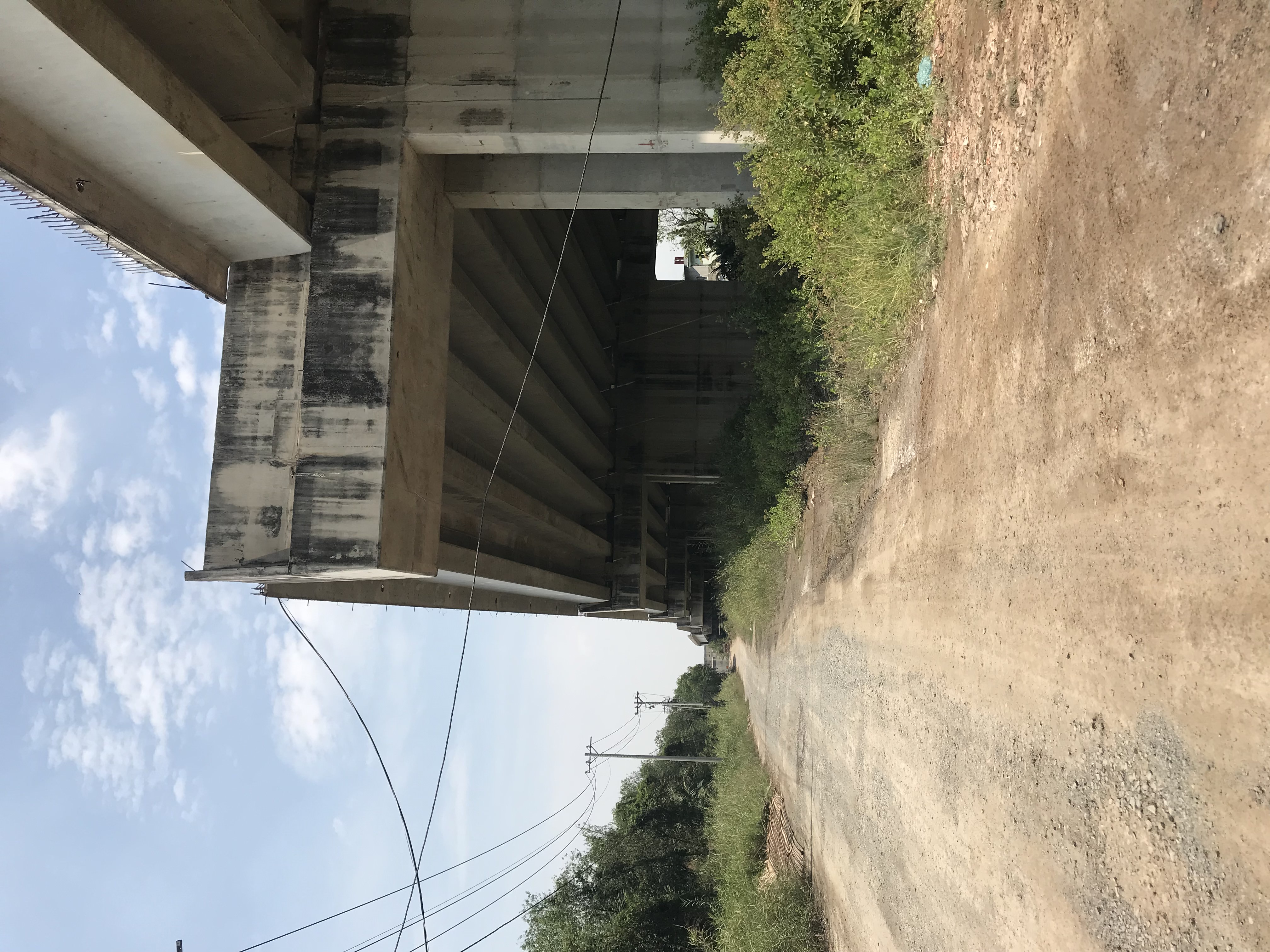
Through a series of field recordings, I’ve been investigating the soundscape of a ‘still’ in-construction (2014 - present time) suspended expressway in Nhon Duc ward located in Nha Be, a suburban district of Ho Chi Minh City in Vietnam. This 57-km long massive suspended expressway (e.g., Ben Luc - Long Thanh Expressway) gets constructed segments at different point along the drawn pathway, in which locals have access to it to freely use it while the road function is not available yet for vehicles. This setup offers me the latitude to explore at different height the sonic atmosphere that occurs between wild life jungle prints and the vertical presence of this cement display, in which the sound of life is amplified by the reverb occurrence of this heavy and massive man-made structure.
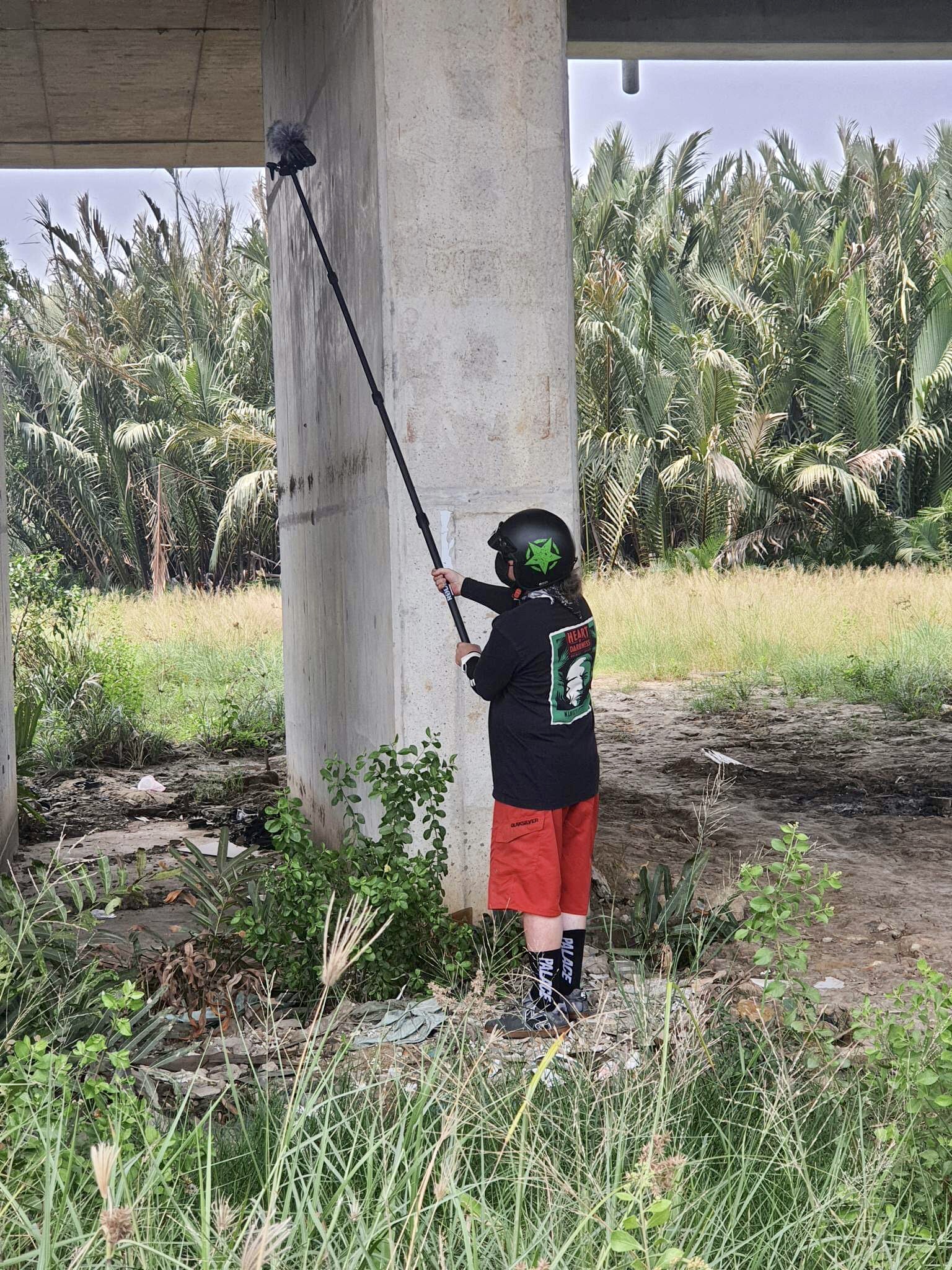
The Lifted Motorway extends the trajectory of verticality within my practice, deepening the engagement with sonic space as both a physical and affective field. Whereas Black River (see Research Project #3) explored vertical listening across bridges and tides, this project shifted the perspective beneath a massive, elevated expressway, framing the structure as a resonant and responsive body suspended between land and sky. Field recordings and performances were conducted at different vertical levels—on the ground and elevated via boom pole—capturing stratified sonic layers shaped by material resonance, atmospheric conditions, and shifting environment activities.
This project not only reinforced verticality as a method employed to field recordings but also revealed how infrastructure and environment co-produce atmospheres charged with presence. Verticality, in this context, also emerged as a conceptual vehicle—its ascending connotation aligning with the idea of extra-forces or spiritual presences that seem to rise beyond the material. The site’s acoustic presences and spatial textures opened a space for sensing something more—an unseen but felt dimension, echoing Thần Thổ Địa, the spirit of the land. The motorway, in this context, was no longer a passive structure but an active participant in a shared sonic and affective ecology.
The Lifted Motorway project invites audiences to hear beyond the aural surface—to experience a space where the material, the spectral, and the environmental merge. It builds on and reconfigures the principles of Black River (see Research Project #3), moving from urban canals to a suspended infrastructure surrounded by jungle, and from observational recording to performative, more-than-noise engagement.
PHOTO-PANORAMA:





PRS#3 - M2
Home Page

Project Outcome: Black River [video]:
Project [Installation]:
JUL 2022
OCT 2022
PRS ASIA
Project Panorama:
Bridge 1
Bridge 1
Bridge 2
Bridge 2
Bridge 3
Bridge 4
Bridge 4
Bridge 4
Bridge 5
Project [Installation]:
JUL 2022
OCT 2022
PRS ASIA
︎
Project Panorama:
Bridge 1
Bridge 1
Bridge 2
Bridge 2
Bridge 3
Bridge 4
Bridge 4
Bridge 4
Bridge 5
PROJECT#3
Black River
Concept Finding: Verticality
Through a series of field recordings, I investigated the soundscape of the ‘Black River’ in Nha Be, a suburban district of Ho Chi Minh City in Vietnam.
The title reflects the physical qualities of this stretch of a canal that is heavily polluted by the domestic and industrial wastewater lead with a characteristic odour of rotten eggs due to heavy metals presence, but also echoes a project at the beginning of my PhD journey, in which I deconstructed a local Heavy Metal band within the form of a sound installation that occurred at Gallerie Quynh in downtown Saigon, Vietnam.
To capture the micro noises of the canal, I used a number of specialist contact-microphones and hydrophones to allow the place to speak to me by unveiling micro noises and audible silence.
These explorations have developed my understanding of the tidal values of the canal (all waterways in HCMC are tidal), and its impact on the atmosphere of this part of the city due to its highs and lows. These micro noises I have explored through alternative explorations and compositional methods, are elaborated on the theme of: Reflection, Absence, Presence, and Atmospheric Black Metal music.
These have led to develop sound works that reflect the atmosphere; acoustic conditions, and ambient characteristics of the space and place, through the verticality aspect of the canal’s water level.
The Research: Black River (Cay Me canal)
Methodology: Collecting Data
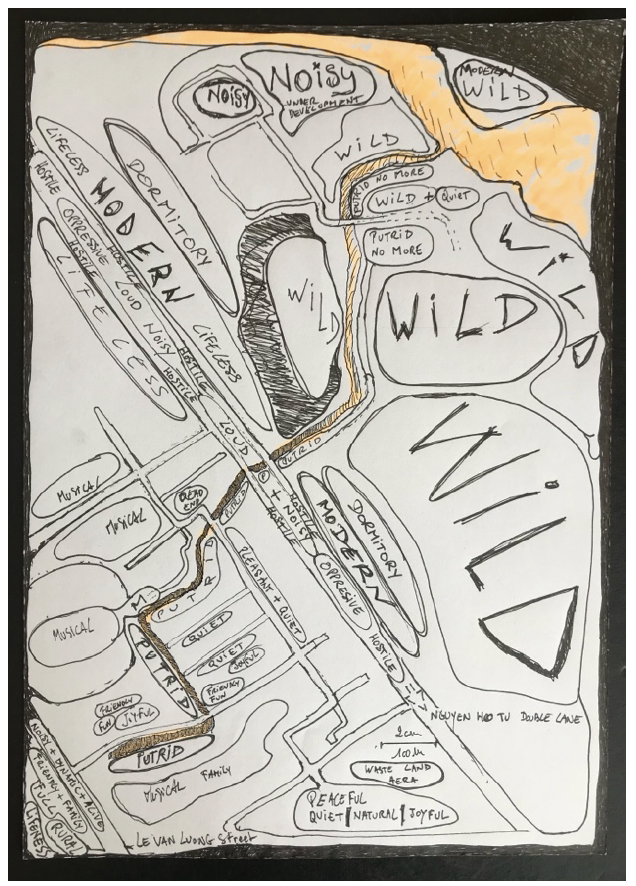
My research employs a practice-based method through the production of creative works that conduct analytical and reflective outputs. A series of visual sketches has been produced to highlight the sonic intensity and atmosphere that was occurring along the canal at the intersection with the bridges.
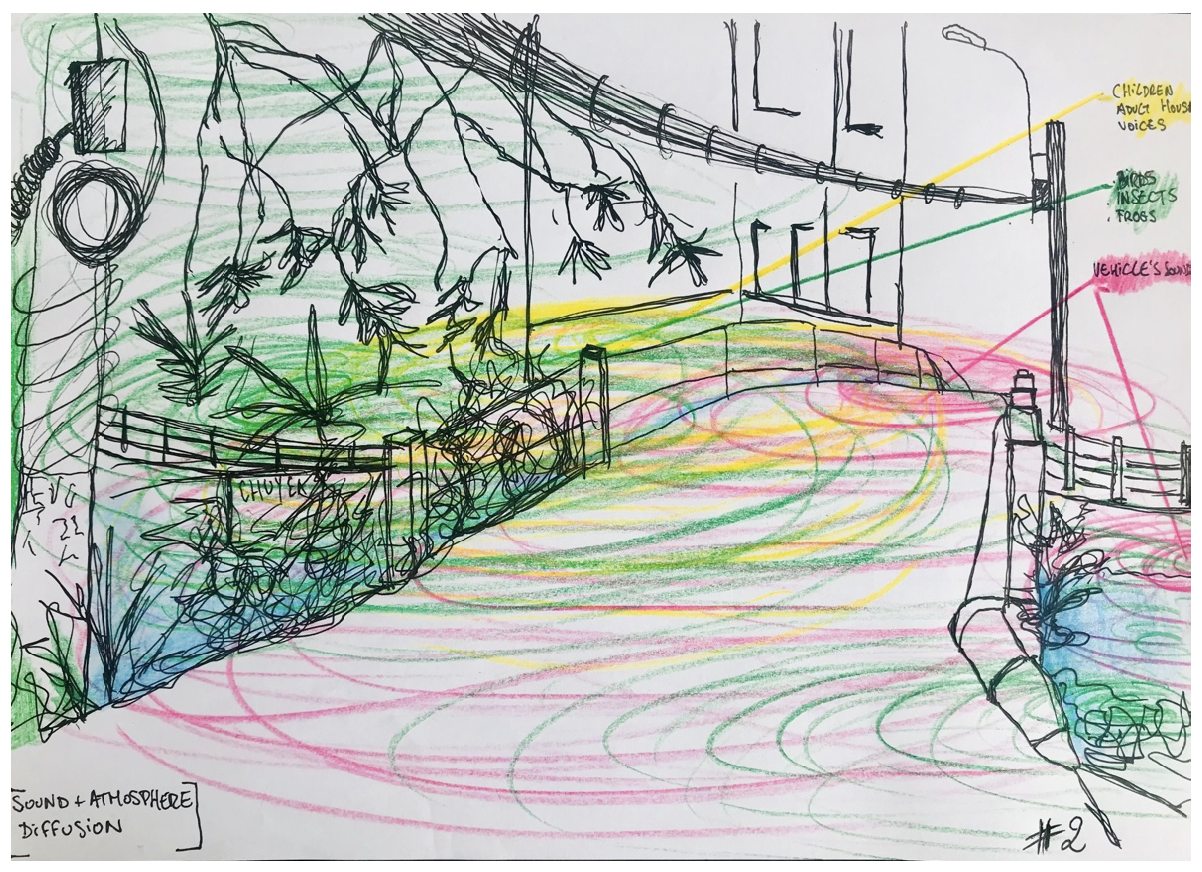
These sessions participated in developing different types of aural topography / cartography of the spaces and places.


Audio Devices and Equipment
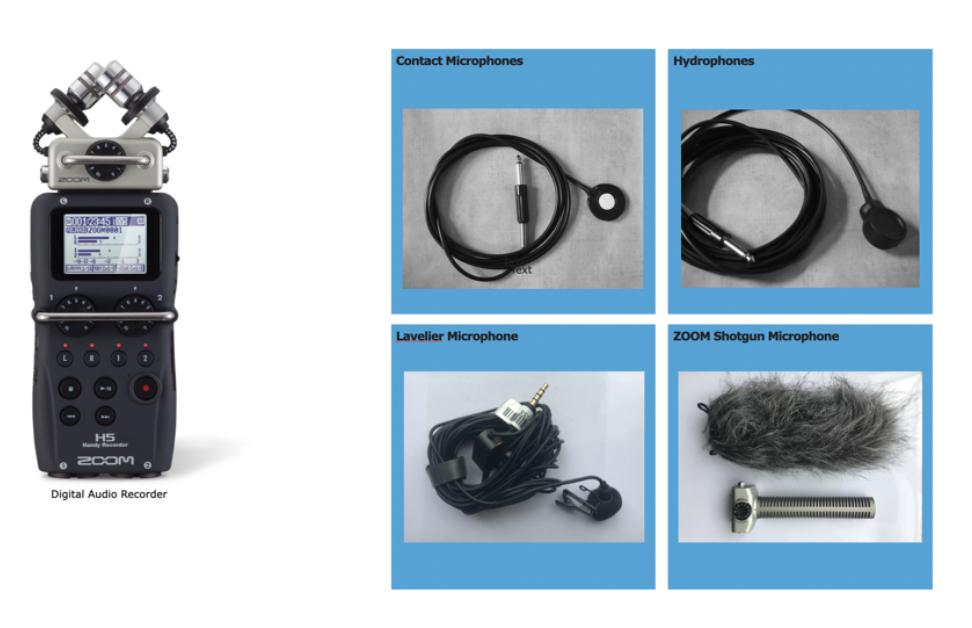
In addition to experiencing the fields in person, various techniques for capturing the soundscape were also created. I employed various types of microphones such as Lavelier, Shotgun, Contact Mic and Hydrophone hooked up to a ZOOM H4N audio digital recorder mounted with a pair of stereo mics.
The Fisherman Camouflage
Additionally, depending on where I was recording, I developed specific techniques to extend the distance between the audio recorder and the microphone by using props. During this period, I began to adopt a form of camouflage to beter fit into the environment, especially when other people were present. As shown The Fisherman Camouflage (see below image), I adopted a posture similar to that of a fisherman to blend in. This way, I aimed to be respectful of the space and not disrupt it by adopting a similar activity than others.

This approach also helped me prevent people from asking questions while I was recording, avoiding any disturbances in my recording sessions from nearby human voices, which is not a focus of this project.
PRS#1
Home Page
Project Outcome: Dismembering Echoes [music performance]
APR 2019
PRS ASIA
![]()
![]()
![]()
![]()
![]()
![]()
![]()
![]()
![]()
![]()
![]()
![]()
![]()
![]()
APR 2019
PRS ASIA
︎
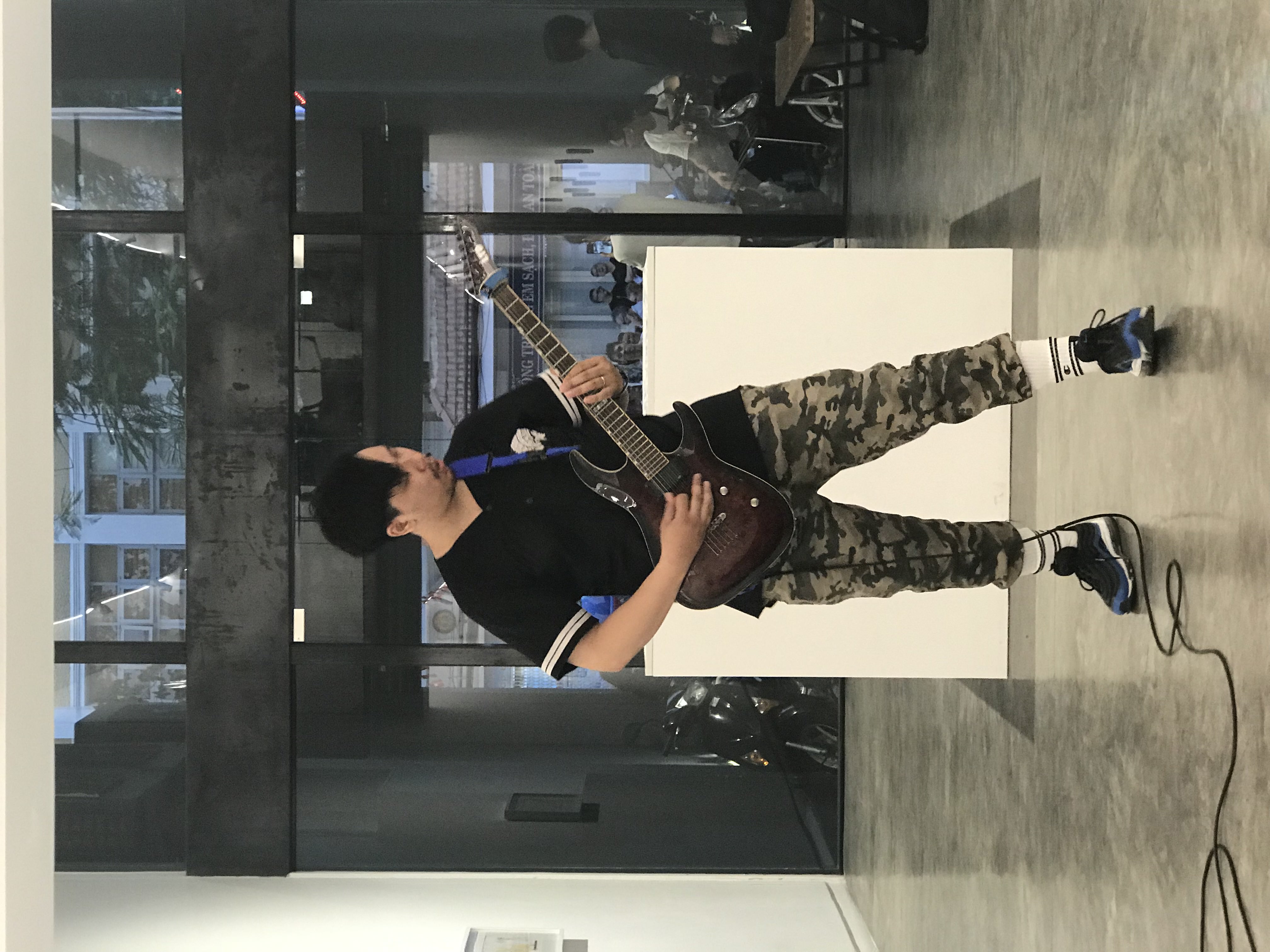


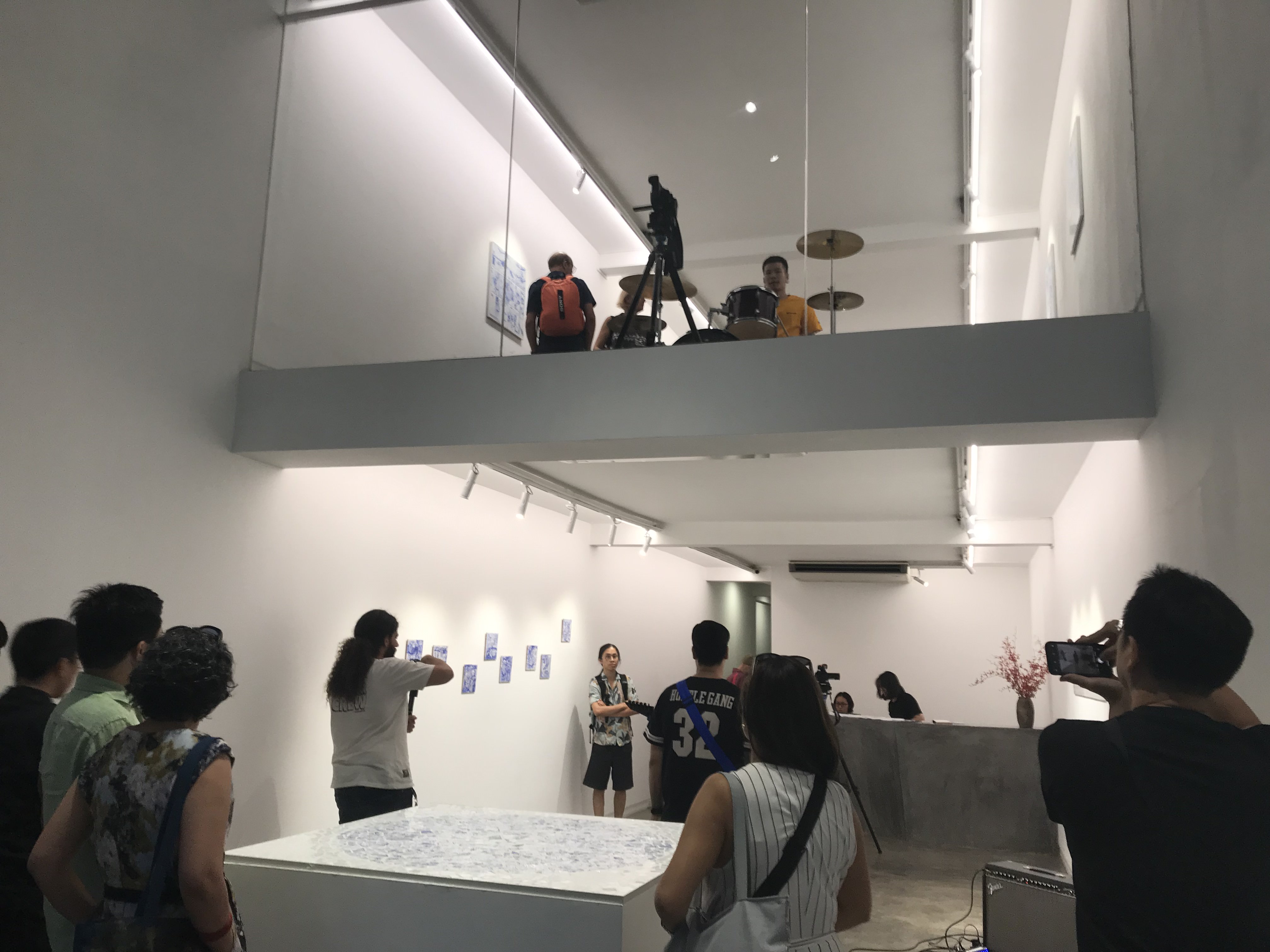
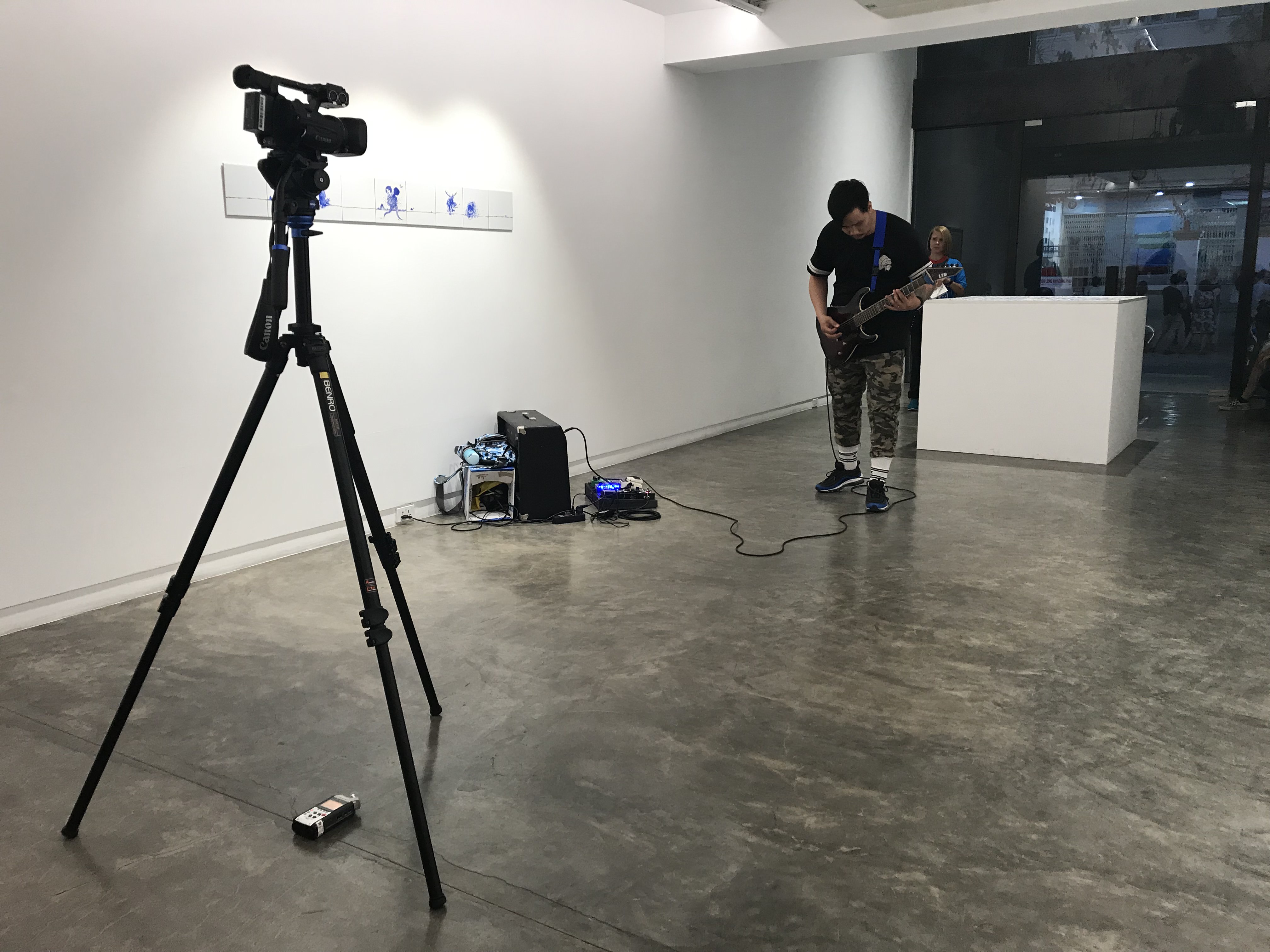


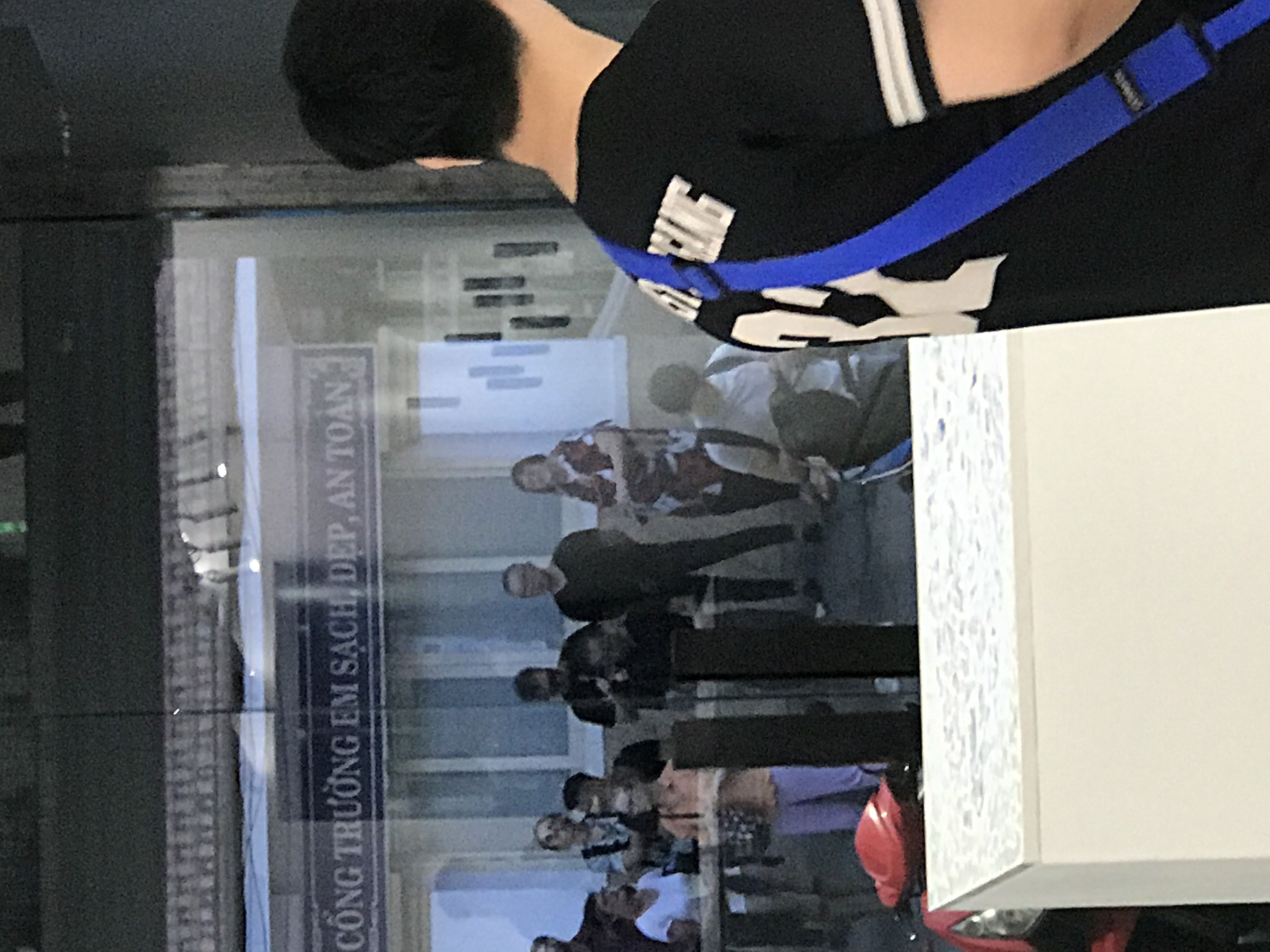


Project#1
DISMEMBERING ECHOES
Concept Finding: Listening
The first project started at the beginning of the PRS ASIA was Dismembering Echoes-2019.
It was a transitional project. The transition is evidenced by transitioning the themes of metal music genres into a gallery space [Galerie Quynh, District 1 Saigon Vietnam].
Dismembering Echoes explored the verticality of breaking apart members of a hardcore metal band across different floors within a four-floor gallery. The music introduced physical spatiality, through the need to visit each floor to experience each instrument. Alternatively, the audience could relocate to the street to experience the collective sound.
This dismembered performance revealed several interesting themes. Firstly, I reflected upon the disruption to the existing exhibition within the gallery. I was not part of this exhibition directly as a performer. But instead, I have planned and conceptualized the performance and gallery settings, in which I have placed a hardcore metal band of Saigon to perform their music within specific defined rules, and it acted as an externally generated set of properties that were disrupted by my impact on the ambience of the show and the gallery. This situation places in the foreground the “spatial orientation of the music that goes beyond the spatial characteristics that defines the site specificity of the space” (Klein 2009, 1).
Secondly the role of the sound listening experience and the gallery atmosphere, was this moment of transition between my reference to music and genre, primarily looking at the composition (melody, harmony, structure) to more specifically at noise itself (tone / intensity / randomness) and its spatialization.
SUMMARY
This moment helped me understand listening not as a means of isolating or dissecting sound, but as a relational and creative act—one that moves across time, materials, and meanings. Listening became a way of noticing how things resonate, how they affect one another, how they gather and disperse. It was not about categorizing the sounds I encountered but attuning to how they mattered—how they shaped the atmosphere, the experience, and the sense of presence. This reflection strongly resonated with ideas I later encountered in sonic materialism: that sound has an environmental affect and is entangled with the conditions of its surroundings.
The project revealed that listening, for me, was not only about collecting or documenting sound. It was about surrendering to its uncertainty, allowing it to transform perception. That encounter with Dismembering Echoes, standing at a distance, enveloped by overlapping vibrations, marked a turning point in how I began to define listening as research practice. It was no longer just an act of hearing. It was a way of being with the world.
Dismembering Echoes marked a turning point in how I understood listening—not as a passive act, but as an active, embodied engagement with noise and environment. What I expected to be chaotic or disjointed—due to the building’s hard surfaces and mostly empty spaces that allowed sound to bounce and reverberate freely—turned into a moment of deep attunement between the musicians and the environment. Rather than disrupting the performance, the architecture acted almost like an amplifier. Instead of dulling the sound or creating confusion, it enhanced the experience—it was loud, heavy, and intensely present. The performance revealed that noise is not merely disruptive, but a material that shapes how we experience place. It invited a different kind of listening—immersive, relational, and responsive. From this point forward, listening in my work became a method to let it reveal how bodies, spaces, and atmospheres resonate together.
PRS#2 - CoC
Home Page
OCT 2021
MAY 2022
PRS ASIA
The Studio-Window Projects:
Listening: https://studentlab1.rmit.edu.vn/%7Ev81013/index1.html
Imaginary Soundscape: https://studentlab1.rmit.edu.vn/%7Ev81013/index.html
Something in the Air: https://studentlab1.rmit.edu.vn/%7Ev81013/index2.html
![]()
![]()
![]()


![]()
MAY 2022
PRS ASIA
︎
The Studio-Window Projects:
Listening: https://studentlab1.rmit.edu.vn/%7Ev81013/index1.html
Imaginary Soundscape: https://studentlab1.rmit.edu.vn/%7Ev81013/index.html
Something in the Air: https://studentlab1.rmit.edu.vn/%7Ev81013/index2.html
The Studio
Sounds: electric guitar, guitar amp, fan
Compositional Effects: drone, emergence, mask
Electroacoustic Effects: larsen/feedback, expansion
Sounds: electric guitar, guitar amp, fan
Compositional Effects: drone, emergence, mask
Electroacoustic Effects: larsen/feedback, expansion


The Living Room
Sounds: electric guitar, guitar amp, fan
Compositional Effects: drone, emergence, mask
Electroacoustic Effects: larsen/feedback, expansion
Sounds: electric guitar, guitar amp, fan
Compositional Effects: drone, emergence, mask
Electroacoustic Effects: larsen/feedback, expansion
The Studio
Sounds: electric guitar, guitar amp, fan
Compositional Effects: drone, emergence, mask
Electroacoustic Effects: larsen/feedback, expansion
Sounds: electric guitar, guitar amp, fan
Compositional Effects: drone, emergence, mask
Electroacoustic Effects: larsen/feedback, expansion
PROJECT#2 -Studio-Window Project
is an exploration of the Soundscape of my living area in South Saigon, Vietnam.Concept Finding: Interior/Exterior
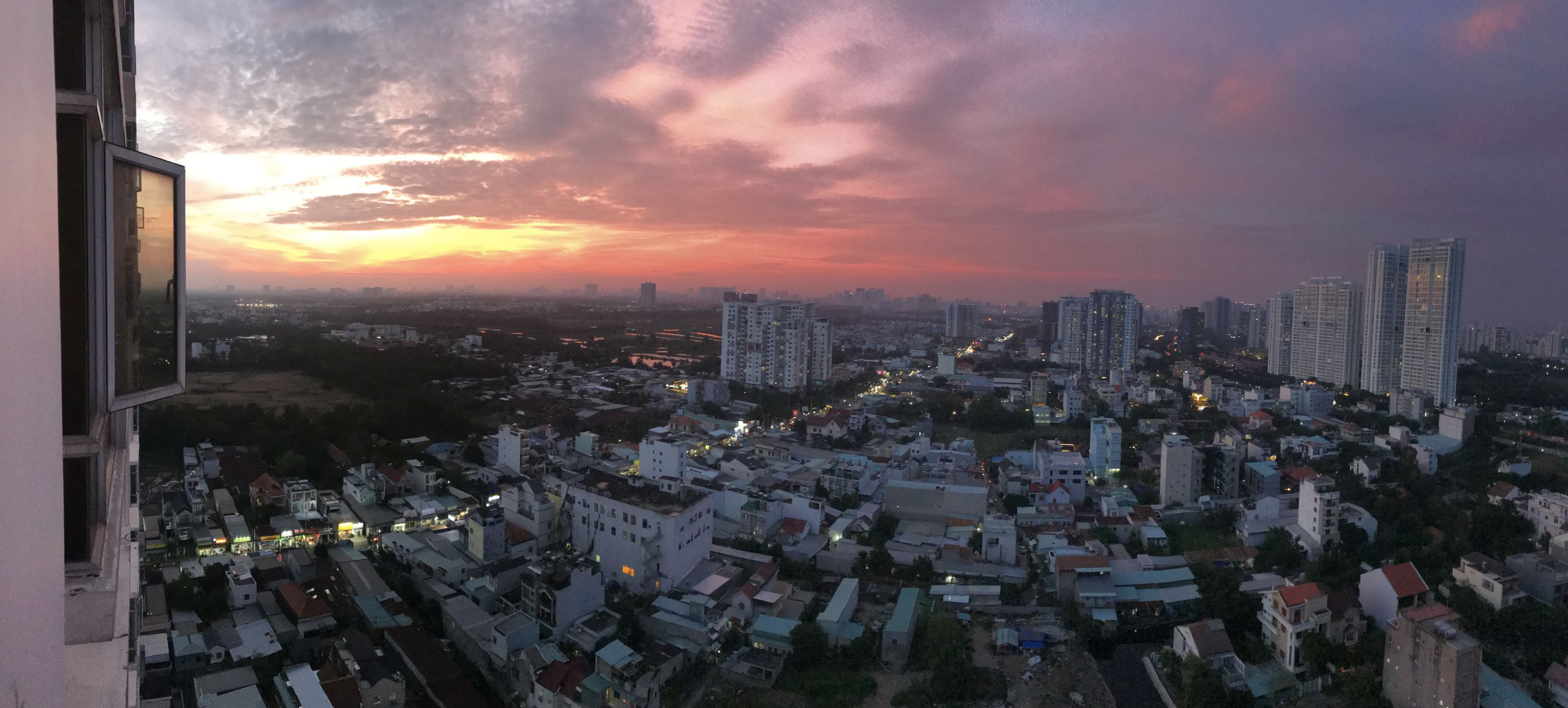
I started to listen to the soundscape while doing field recordings from my window studio.
In response to the lockdown situation I intended to reconstruct through my imaginative responses the missing experience of listening to the ambient sounds. Audio manipulation through sound synthesis techniques as a conceptual approach has been used.
CONTEXT 1
Living in Nha Be District, my window studio is located at the 25th floor. During the lockdown, I was listening and recording the sounds through the window, and I was thinking how I will do this research at the soundscape when the soundscape of the city is mainly absent. The notion of auditory imaginary (Imaginary Soundscapes) started naturally to resonate within the practice.
Drawing on the book of CRESSON's Sonic experience, a guide to everyday sounds that "focuses on the effects of sound on listeners [...] in the contexts of architectural and urban spaces" (Augoyard and Torgue 2005: xiii), a selection of perceptive and semantic sound effects were undertaken.These sonic effects are:
Drawing on the book of CRESSON's Sonic experience, a guide to everyday sounds that "focuses on the effects of sound on listeners [...] in the contexts of architectural and urban spaces" (Augoyard and Torgue 2005: xiii), a selection of perceptive and semantic sound effects were undertaken.These sonic effects are:
- Anamnesis - "An effect of reminiscence in which a past situation or atmosphere is brought back to the listener's conciousness, provoked by a particular signal or sonic context." (p.21)
- Imitation - "it re-represents particularly significant features of the style of reference." (p.59)
- Phonomnesis - "This effect refers to a sound that is imagined but not actually heard." (p.85)
- Remanence - "the impression of hearing a continuous drone; or melismatic movements that make an absent sound virtually present." (p.87)
- Sharawadji - "created by the contemplation of a sound motif or a complex soundscape [...] and stimulates a feeling of pleasure in the perceptive confusion." (p.117-118)
On the other hand, the research is lying on the concept of Sound Object. Michel Chion's Guide to Sound Objects aims "of providing a dictionary of the main key-concepts (often presented in pairs) in Pierre Schaeffer's Traité des Objets Musicaux" (Michel Chion 2009: 7). These Sound Objects refer to the morphology of sound.
These sound objects are:
Project#2 Studio-Window Something in the Air
is an exploration of the atmospherics condition of a room through the use of audio tools. This project is originally inspired by the perceived relationships and energy transfer principles within environments/spaces and sonic ambient fields, in which composer and sound artists perceive themselves as "noise generators" (Di Scipio, 1999, « Il compositore come generatore di rumore ». Musica/Realtà, n° 60) from interactive to ecosystems.
CONTEXT Something in the Air [genesis]
[Notes from my Diary]
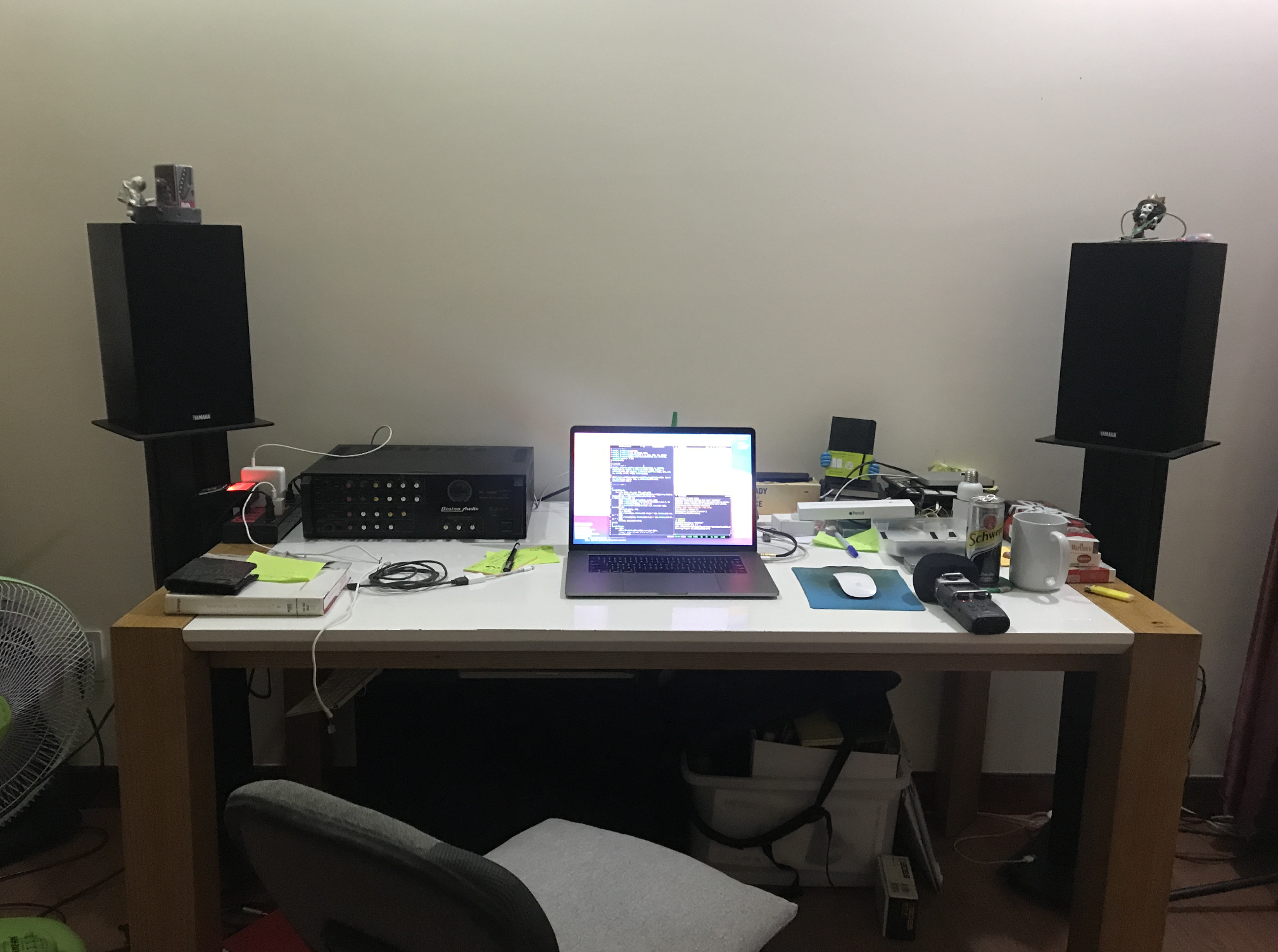
It was a hot and humid day. Nothing special for the weather conditions of a city like Saigon, South Vietnam. The sound conditions were a priori normal. An electric guitar, an amplifier and some effects pedals as usual. But, something was wrong. My guitar sounded different. All the hardware was assembled as usual, but the sound of the guitar was not what I expected. It bothered me to the point that I didn't pay attention to what I was playing because I kept thinking about it.
After a while, I noticed that strange noises were coming out from the amplifier. They sounded like noisy parasites, mixing unstable crackles and other filtered effects. These parasites apparently had an effect on the sound of the guitar. Moreover, I have quite a particular condition with my equipment. The amplifier power supply is not very stable. The power cable is loose and this can cause variations in the power supply which can prevent the amplifier from working properly by releasing interferences. This also affects the electronic tube of the amp, which gives a particular feeling and timbre when I play. That's why I try to maintain this cable with what I have under my hand. A pack of cigarettes, a lighter or a marker. Anything that can keep this cable connected.
Then, there is also the room in which I find myself. I live in a duplex apartment, at the 24th and 25th floor. Of course, there are sounds coming from the surroundings. On the one hand, the sound from the neighbors on the other side of the wall, or from the ceiling and the floor and as well as from my rooms related to the relatives activity. On the other hand, there is also the sounds coming from outdoors through the window that easily interferes especially when the window is open because of high temperature in the room.
In short, the social relations with my neighborhood, the hot and humid weather, the interaction of the sounds of the room itself and the interaction between the musical and electrical equipment, all of this contributes to creating a rather particular and singular atmosphere. This imprecise thing which controls the ambient atmosphere, without forgetting so to speak of the state of mind or other emotional fatigues, which can in turn enhance the main condition of the atmospherics feeling.
////// The Studio 1 / Audio System 1: Guitar, Amp, Fan [Iteration 3: 21/03/2022 Duration:6'04" Time:2.47PM]
Description of effects: One obvious effect that is observed is the drone* effect that refers to the existence of a consistent pitch layer with notable intensity fluctuation in a sound ensemble (CRESSON 2005: 40).
At the beginning of the recording, the sonic image of the studio is filled by low-frequency noise coming from the humming of the city that is entering through the studio window (100-400HZ). Then, when the guitar amp is switched on, the sonic image of the studio is largely dominated by the mid-range (500-2000HZ) to higher-midrange of the guitar amp (2000-4000Hz), in which electrical disturbances generate filtered variation of noise presence. —— *drone: Many technical systems generate constant sounds that are close to a drone, even if the frequencies concerned are not limited to the bass range that originally characterized it. Synonyms: teneur, continuum —— The launch of the fan triggers the guitar six-string resonance. Even though this new layer of sounds is added, it doesn’t add more high-range to the layers. But instead, it adds more intensity into the sound (e.g., spectrogram). The emergence effect, which is defined by the appearance of sounds that fluctuate in pitch and intensity (CRESSON 2005: 47) when the body is moving in the studio, appears to be enhanced by the acoustic dispersion caused by the physical shape, size, and absence of absorbing materials of the space.
Something in the Air [exploration]
The Studio 1 Experiment
Sounds: electric guitar, guitar amp, fan
Compositional Effects: drone, emergence, mask
Electroacoustic Effects: larsen/feedback, expansion
The Living Room Experiment
Sounds: electric guitar, guitar amp, fan
Compositional Effects: drone, emergence, mask
Electroacoustic Effects: larsen/feedback, expansion
The Studio 2 Experiment
Sounds: laptop, supercollider
Compositional Effects: emergence, mask
Electroacoustic Effects: larsen/feedback, expansion
Semantic Effects: imitation, repetition, suspension
Project Summary:
Together, the three lockdown projects revealed a layered understanding of listening as a situated, responsive, and creative method.
Lockdown Project #1 deepened my engagement with the sonic blur between interior and exterior environments through attuned listening to the building's soundscape.
Lockdown Project #2 extended this by reconstructing absent urban noise through memory and imagination, using audio programming to reanimate the silenced city from within.
Lockdown Project #3 explored the physical influence of environmental conditions—like temperature and humidity—on sound production, expanding the concept of atmosphere as both a sonic and material force.
Collectively, these projects redefined noise and soundscape as fluid, relational, and shaped by lived spatial and temporal conditions.
- Density/Volume - "two very specific criteria only apply here to the study of pure sounds (pure frequencies, without harmonics). Acousticians have singled them out through experiments in psychoacoustics. We could therefore call them “additional qualities” of pure sounds, as they are added on to pitch and intensity." (p.170)
-
Value/Characteristic - "a quality of perception common to different objects (…) enabling these objects to be compared, arranged and (possibly) put into calibrations despite the dissimilarities in their other perceptual aspects." (p.75)
-
Pitch - "is the privileged sound characteristic, the most pregnant with meaning, in the same way as rhythmic pulsation, but also the best able to function as a value and give rise to rich, complex, well-perceived relationships." (p.42)
-
Timbre - "is that particular quality of sound which means that two instruments cannot be confused, even though they are producing a sound of the same pitch and intensity." (p.48)
-
Impulse - "is given to very brief sounds with non-existent or short-lived sustainment." (p.130)
- Musicality/Sonority - "the “sonorous” refers to the jungle of all possible sounds, still without musical function; here it is a question of choosing the sound objects which are judged suitable to become musical objects in certain contexts, and from which “values” have been derived." (p.71)
Project#2 Studio-Window Something in the Air
is an exploration of the atmospherics condition of a room through the use of audio tools. This project is originally inspired by the perceived relationships and energy transfer principles within environments/spaces and sonic ambient fields, in which composer and sound artists perceive themselves as "noise generators" (Di Scipio, 1999, « Il compositore come generatore di rumore ». Musica/Realtà, n° 60) from interactive to ecosystems.CONTEXT Something in the Air [genesis]
[Notes from my Diary]
It was a hot and humid day. Nothing special for the weather conditions of a city like Saigon, South Vietnam. The sound conditions were a priori normal. An electric guitar, an amplifier and some effects pedals as usual. But, something was wrong. My guitar sounded different. All the hardware was assembled as usual, but the sound of the guitar was not what I expected. It bothered me to the point that I didn't pay attention to what I was playing because I kept thinking about it.
After a while, I noticed that strange noises were coming out from the amplifier. They sounded like noisy parasites, mixing unstable crackles and other filtered effects. These parasites apparently had an effect on the sound of the guitar. Moreover, I have quite a particular condition with my equipment. The amplifier power supply is not very stable. The power cable is loose and this can cause variations in the power supply which can prevent the amplifier from working properly by releasing interferences. This also affects the electronic tube of the amp, which gives a particular feeling and timbre when I play. That's why I try to maintain this cable with what I have under my hand. A pack of cigarettes, a lighter or a marker. Anything that can keep this cable connected.
Then, there is also the room in which I find myself. I live in a duplex apartment, at the 24th and 25th floor. Of course, there are sounds coming from the surroundings. On the one hand, the sound from the neighbors on the other side of the wall, or from the ceiling and the floor and as well as from my rooms related to the relatives activity. On the other hand, there is also the sounds coming from outdoors through the window that easily interferes especially when the window is open because of high temperature in the room.
In short, the social relations with my neighborhood, the hot and humid weather, the interaction of the sounds of the room itself and the interaction between the musical and electrical equipment, all of this contributes to creating a rather particular and singular atmosphere. This imprecise thing which controls the ambient atmosphere, without forgetting so to speak of the state of mind or other emotional fatigues, which can in turn enhance the main condition of the atmospherics feeling.
////// The Studio 1 / Audio System 1: Guitar, Amp, Fan [Iteration 3: 21/03/2022 Duration:6'04" Time:2.47PM]
Description of effects: One obvious effect that is observed is the drone* effect that refers to the existence of a consistent pitch layer with notable intensity fluctuation in a sound ensemble (CRESSON 2005: 40).
At the beginning of the recording, the sonic image of the studio is filled by low-frequency noise coming from the humming of the city that is entering through the studio window (100-400HZ). Then, when the guitar amp is switched on, the sonic image of the studio is largely dominated by the mid-range (500-2000HZ) to higher-midrange of the guitar amp (2000-4000Hz), in which electrical disturbances generate filtered variation of noise presence. —— *drone: Many technical systems generate constant sounds that are close to a drone, even if the frequencies concerned are not limited to the bass range that originally characterized it. Synonyms: teneur, continuum —— The launch of the fan triggers the guitar six-string resonance. Even though this new layer of sounds is added, it doesn’t add more high-range to the layers. But instead, it adds more intensity into the sound (e.g., spectrogram). The emergence effect, which is defined by the appearance of sounds that fluctuate in pitch and intensity (CRESSON 2005: 47) when the body is moving in the studio, appears to be enhanced by the acoustic dispersion caused by the physical shape, size, and absence of absorbing materials of the space.
Something in the Air [exploration]
The Studio 1 Experiment
Sounds: electric guitar, guitar amp, fan
Compositional Effects: drone, emergence, mask
Electroacoustic Effects: larsen/feedback, expansion
The Living Room Experiment
Sounds: electric guitar, guitar amp, fan
Compositional Effects: drone, emergence, mask
Electroacoustic Effects: larsen/feedback, expansion
The Studio 2 Experiment
Sounds: laptop, supercollider
Compositional Effects: emergence, mask
Electroacoustic Effects: larsen/feedback, expansion
Semantic Effects: imitation, repetition, suspension
Project Summary:
Together, the three lockdown projects revealed a layered understanding of listening as a situated, responsive, and creative method.
Lockdown Project #1 deepened my engagement with the sonic blur between interior and exterior environments through attuned listening to the building's soundscape.
Lockdown Project #2 extended this by reconstructing absent urban noise through memory and imagination, using audio programming to reanimate the silenced city from within.
Lockdown Project #3 explored the physical influence of environmental conditions—like temperature and humidity—on sound production, expanding the concept of atmosphere as both a sonic and material force.
Collectively, these projects redefined noise and soundscape as fluid, relational, and shaped by lived spatial and temporal conditions.