PRS#2 - CoC
Home Page
OCT 2021
MAY 2022
PRS ASIA
The Studio-Window Projects:
Listening: https://studentlab1.rmit.edu.vn/%7Ev81013/index1.html
Imaginary Soundscape: https://studentlab1.rmit.edu.vn/%7Ev81013/index.html
Something in the Air: https://studentlab1.rmit.edu.vn/%7Ev81013/index2.html
![]()
![]()
![]()


![]()
MAY 2022
PRS ASIA
︎
The Studio-Window Projects:
Listening: https://studentlab1.rmit.edu.vn/%7Ev81013/index1.html
Imaginary Soundscape: https://studentlab1.rmit.edu.vn/%7Ev81013/index.html
Something in the Air: https://studentlab1.rmit.edu.vn/%7Ev81013/index2.html
The Studio
Sounds: electric guitar, guitar amp, fan
Compositional Effects: drone, emergence, mask
Electroacoustic Effects: larsen/feedback, expansion
Sounds: electric guitar, guitar amp, fan
Compositional Effects: drone, emergence, mask
Electroacoustic Effects: larsen/feedback, expansion


The Living Room
Sounds: electric guitar, guitar amp, fan
Compositional Effects: drone, emergence, mask
Electroacoustic Effects: larsen/feedback, expansion
Sounds: electric guitar, guitar amp, fan
Compositional Effects: drone, emergence, mask
Electroacoustic Effects: larsen/feedback, expansion
The Studio
Sounds: electric guitar, guitar amp, fan
Compositional Effects: drone, emergence, mask
Electroacoustic Effects: larsen/feedback, expansion
Sounds: electric guitar, guitar amp, fan
Compositional Effects: drone, emergence, mask
Electroacoustic Effects: larsen/feedback, expansion
PROJECT#2 -Studio-Window Project
is an exploration of the Soundscape of my living area in South Saigon, Vietnam.Concept Finding: Interior/Exterior
I started to listen to the soundscape while doing field recordings from my window studio.
In response to the lockdown situation I intended to reconstruct through my imaginative responses the missing experience of listening to the ambient sounds. Audio manipulation through sound synthesis techniques as a conceptual approach has been used.
CONTEXT 1
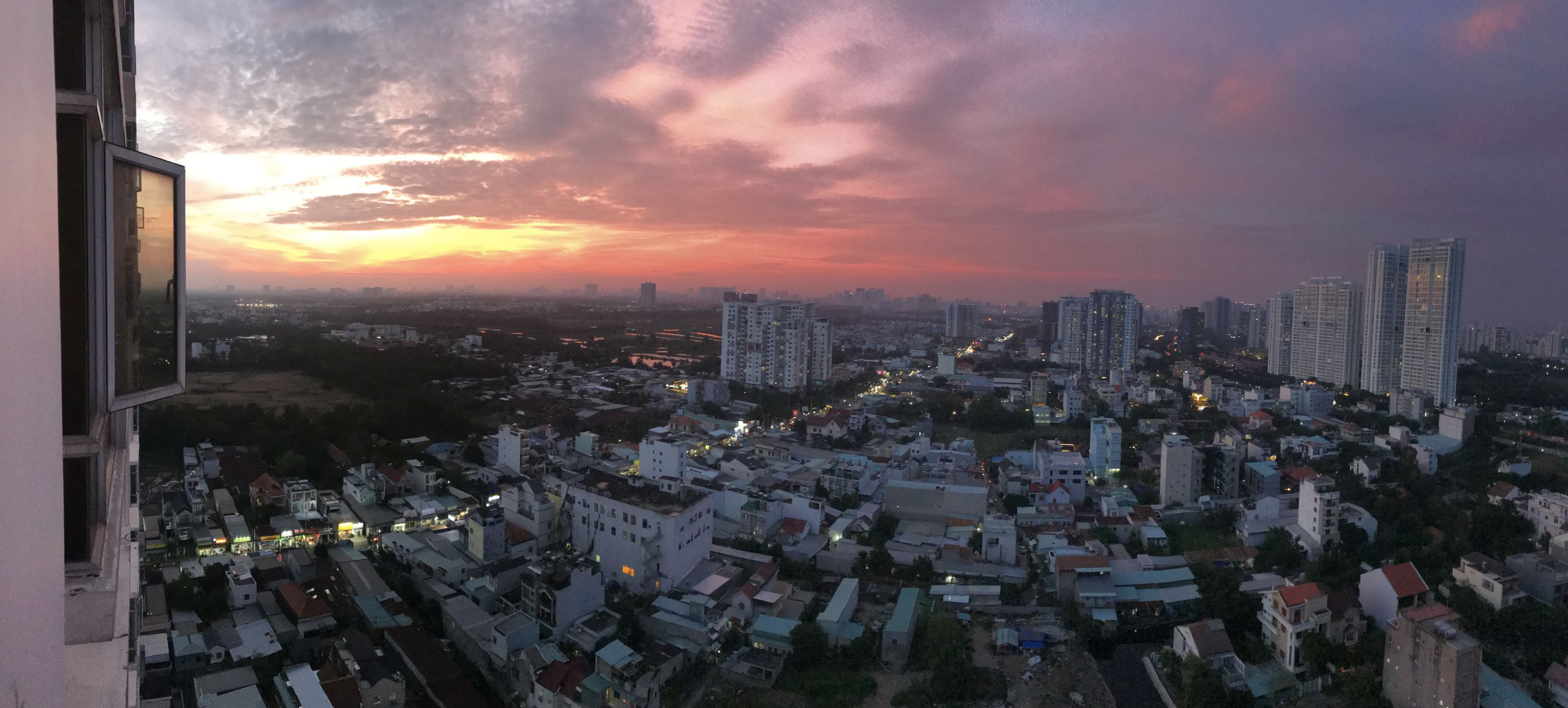
Living in Nha Be District, my window studio is located at the 25th floor. During the lockdown, I was listening and recording the sounds through the window, and I was thinking how I will do this research at the soundscape when the soundscape of the city is mainly absent. The notion of auditory imaginary (Imaginary Soundscapes) started naturally to resonate within the practice.
Drawing on the book of CRESSON's Sonic experience, a guide to everyday sounds that "focuses on the effects of sound on listeners [...] in the contexts of architectural and urban spaces" (Augoyard and Torgue 2005: xiii), a selection of perceptive and semantic sound effects were undertaken.These sonic effects are:
Drawing on the book of CRESSON's Sonic experience, a guide to everyday sounds that "focuses on the effects of sound on listeners [...] in the contexts of architectural and urban spaces" (Augoyard and Torgue 2005: xiii), a selection of perceptive and semantic sound effects were undertaken.These sonic effects are:
- Anamnesis - "An effect of reminiscence in which a past situation or atmosphere is brought back to the listener's conciousness, provoked by a particular signal or sonic context." (p.21)
- Imitation - "it re-represents particularly significant features of the style of reference." (p.59)
- Phonomnesis - "This effect refers to a sound that is imagined but not actually heard." (p.85)
- Remanence - "the impression of hearing a continuous drone; or melismatic movements that make an absent sound virtually present." (p.87)
- Sharawadji - "created by the contemplation of a sound motif or a complex soundscape [...] and stimulates a feeling of pleasure in the perceptive confusion." (p.117-118)
On the other hand, the research is lying on the concept of Sound Object. Michel Chion's Guide to Sound Objects aims "of providing a dictionary of the main key-concepts (often presented in pairs) in Pierre Schaeffer's Traité des Objets Musicaux" (Michel Chion 2009: 7). These Sound Objects refer to the morphology of sound.
These sound objects are:
Project#2 Studio-Window Something in the Air
is an exploration of the atmospherics condition of a room through the use of audio tools. This project is originally inspired by the perceived relationships and energy transfer principles within environments/spaces and sonic ambient fields, in which composer and sound artists perceive themselves as "noise generators" (Di Scipio, 1999, « Il compositore come generatore di rumore ». Musica/Realtà, n° 60) from interactive to ecosystems.
CONTEXT Something in the Air [genesis]
[Notes from my Diary]
It was a hot and humid day. Nothing special for the weather conditions of a city like Saigon, South Vietnam. The sound conditions were a priori normal. An electric guitar, an amplifier and some effects pedals as usual. But, something was wrong. My guitar sounded different. All the hardware was assembled as usual, but the sound of the guitar was not what I expected. It bothered me to the point that I didn't pay attention to what I was playing because I kept thinking about it.
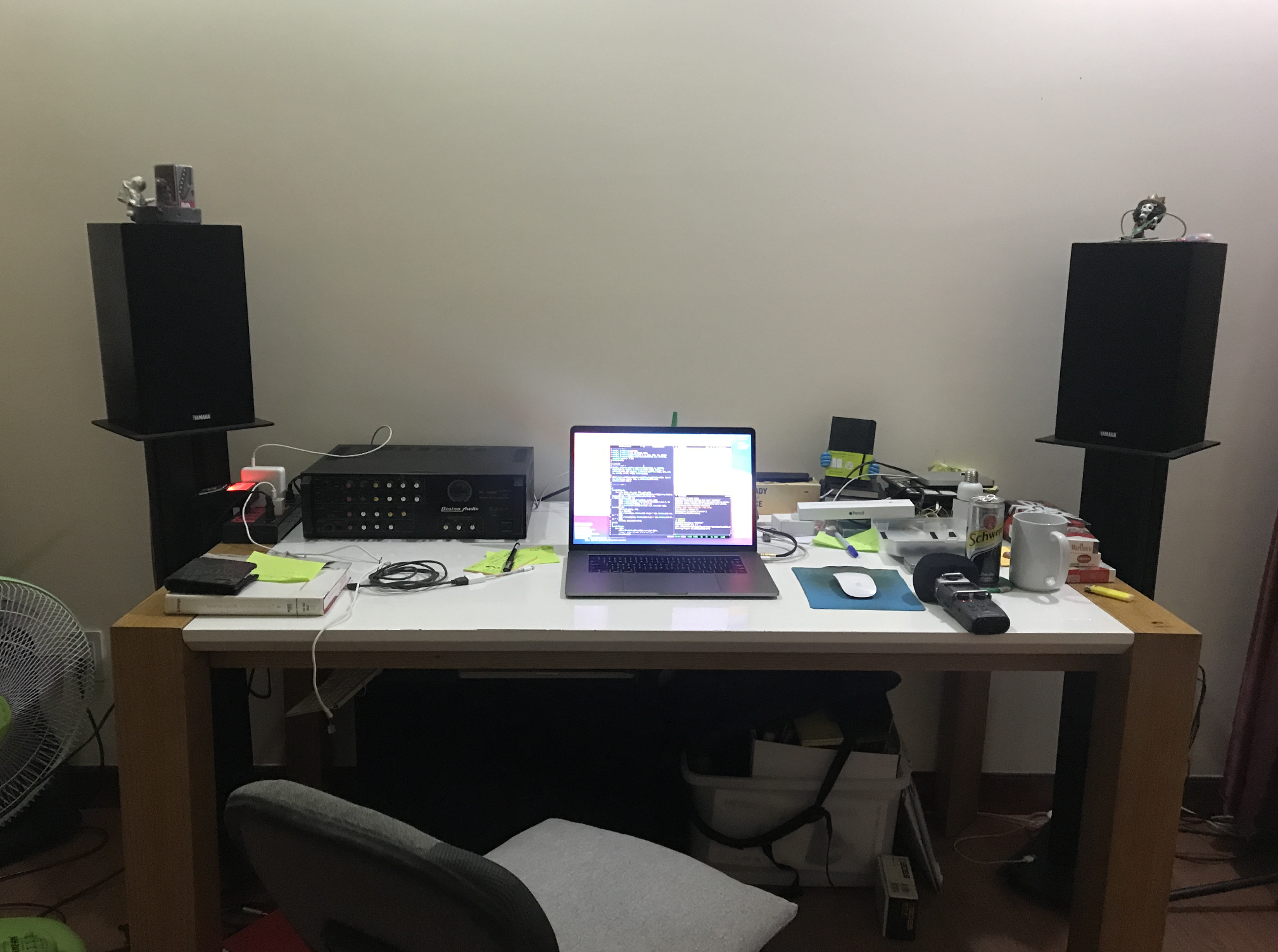
After a while, I noticed that strange noises were coming out from the amplifier. They sounded like noisy parasites, mixing unstable crackles and other filtered effects. These parasites apparently had an effect on the sound of the guitar. Moreover, I have quite a particular condition with my equipment. The amplifier power supply is not very stable. The power cable is loose and this can cause variations in the power supply which can prevent the amplifier from working properly by releasing interferences. This also affects the electronic tube of the amp, which gives a particular feeling and timbre when I play. That's why I try to maintain this cable with what I have under my hand. A pack of cigarettes, a lighter or a marker. Anything that can keep this cable connected.
Then, there is also the room in which I find myself. I live in a duplex apartment, at the 24th and 25th floor. Of course, there are sounds coming from the surroundings. On the one hand, the sound from the neighbors on the other side of the wall, or from the ceiling and the floor and as well as from my rooms related to the relatives activity. On the other hand, there is also the sounds coming from outdoors through the window that easily interferes especially when the window is open because of high temperature in the room.
In short, the social relations with my neighborhood, the hot and humid weather, the interaction of the sounds of the room itself and the interaction between the musical and electrical equipment, all of this contributes to creating a rather particular and singular atmosphere. This imprecise thing which controls the ambient atmosphere, without forgetting so to speak of the state of mind or other emotional fatigues, which can in turn enhance the main condition of the atmospherics feeling.
////// The Studio 1 / Audio System 1: Guitar, Amp, Fan [Iteration 3: 21/03/2022 Duration:6'04" Time:2.47PM]
Description of effects: One obvious effect that is observed is the drone* effect that refers to the existence of a consistent pitch layer with notable intensity fluctuation in a sound ensemble (CRESSON 2005: 40).
At the beginning of the recording, the sonic image of the studio is filled by low-frequency noise coming from the humming of the city that is entering through the studio window (100-400HZ). Then, when the guitar amp is switched on, the sonic image of the studio is largely dominated by the mid-range (500-2000HZ) to higher-midrange of the guitar amp (2000-4000Hz), in which electrical disturbances generate filtered variation of noise presence. —— *drone: Many technical systems generate constant sounds that are close to a drone, even if the frequencies concerned are not limited to the bass range that originally characterized it. Synonyms: teneur, continuum —— The launch of the fan triggers the guitar six-string resonance. Even though this new layer of sounds is added, it doesn’t add more high-range to the layers. But instead, it adds more intensity into the sound (e.g., spectrogram). The emergence effect, which is defined by the appearance of sounds that fluctuate in pitch and intensity (CRESSON 2005: 47) when the body is moving in the studio, appears to be enhanced by the acoustic dispersion caused by the physical shape, size, and absence of absorbing materials of the space.
Something in the Air [exploration]
The Studio 1 Experiment
Sounds: electric guitar, guitar amp, fan
Compositional Effects: drone, emergence, mask
Electroacoustic Effects: larsen/feedback, expansion
The Living Room Experiment
Sounds: electric guitar, guitar amp, fan
Compositional Effects: drone, emergence, mask
Electroacoustic Effects: larsen/feedback, expansion
The Studio 2 Experiment
Sounds: laptop, supercollider
Compositional Effects: emergence, mask
Electroacoustic Effects: larsen/feedback, expansion
Semantic Effects: imitation, repetition, suspension
Project Summary:
Together, the three lockdown projects revealed a layered understanding of listening as a situated, responsive, and creative method.
Lockdown Project #1 deepened my engagement with the sonic blur between interior and exterior environments through attuned listening to the building's soundscape.
Lockdown Project #2 extended this by reconstructing absent urban noise through memory and imagination, using audio programming to reanimate the silenced city from within.
Lockdown Project #3 explored the physical influence of environmental conditions—like temperature and humidity—on sound production, expanding the concept of atmosphere as both a sonic and material force.
Collectively, these projects redefined noise and soundscape as fluid, relational, and shaped by lived spatial and temporal conditions.
- Density/Volume - "two very specific criteria only apply here to the study of pure sounds (pure frequencies, without harmonics). Acousticians have singled them out through experiments in psychoacoustics. We could therefore call them “additional qualities” of pure sounds, as they are added on to pitch and intensity." (p.170)
-
Value/Characteristic - "a quality of perception common to different objects (…) enabling these objects to be compared, arranged and (possibly) put into calibrations despite the dissimilarities in their other perceptual aspects." (p.75)
-
Pitch - "is the privileged sound characteristic, the most pregnant with meaning, in the same way as rhythmic pulsation, but also the best able to function as a value and give rise to rich, complex, well-perceived relationships." (p.42)
-
Timbre - "is that particular quality of sound which means that two instruments cannot be confused, even though they are producing a sound of the same pitch and intensity." (p.48)
-
Impulse - "is given to very brief sounds with non-existent or short-lived sustainment." (p.130)
- Musicality/Sonority - "the “sonorous” refers to the jungle of all possible sounds, still without musical function; here it is a question of choosing the sound objects which are judged suitable to become musical objects in certain contexts, and from which “values” have been derived." (p.71)
Project#2 Studio-Window Something in the Air
is an exploration of the atmospherics condition of a room through the use of audio tools. This project is originally inspired by the perceived relationships and energy transfer principles within environments/spaces and sonic ambient fields, in which composer and sound artists perceive themselves as "noise generators" (Di Scipio, 1999, « Il compositore come generatore di rumore ». Musica/Realtà, n° 60) from interactive to ecosystems.CONTEXT Something in the Air [genesis]
[Notes from my Diary]
It was a hot and humid day. Nothing special for the weather conditions of a city like Saigon, South Vietnam. The sound conditions were a priori normal. An electric guitar, an amplifier and some effects pedals as usual. But, something was wrong. My guitar sounded different. All the hardware was assembled as usual, but the sound of the guitar was not what I expected. It bothered me to the point that I didn't pay attention to what I was playing because I kept thinking about it.
After a while, I noticed that strange noises were coming out from the amplifier. They sounded like noisy parasites, mixing unstable crackles and other filtered effects. These parasites apparently had an effect on the sound of the guitar. Moreover, I have quite a particular condition with my equipment. The amplifier power supply is not very stable. The power cable is loose and this can cause variations in the power supply which can prevent the amplifier from working properly by releasing interferences. This also affects the electronic tube of the amp, which gives a particular feeling and timbre when I play. That's why I try to maintain this cable with what I have under my hand. A pack of cigarettes, a lighter or a marker. Anything that can keep this cable connected.
Then, there is also the room in which I find myself. I live in a duplex apartment, at the 24th and 25th floor. Of course, there are sounds coming from the surroundings. On the one hand, the sound from the neighbors on the other side of the wall, or from the ceiling and the floor and as well as from my rooms related to the relatives activity. On the other hand, there is also the sounds coming from outdoors through the window that easily interferes especially when the window is open because of high temperature in the room.
In short, the social relations with my neighborhood, the hot and humid weather, the interaction of the sounds of the room itself and the interaction between the musical and electrical equipment, all of this contributes to creating a rather particular and singular atmosphere. This imprecise thing which controls the ambient atmosphere, without forgetting so to speak of the state of mind or other emotional fatigues, which can in turn enhance the main condition of the atmospherics feeling.
////// The Studio 1 / Audio System 1: Guitar, Amp, Fan [Iteration 3: 21/03/2022 Duration:6'04" Time:2.47PM]
Description of effects: One obvious effect that is observed is the drone* effect that refers to the existence of a consistent pitch layer with notable intensity fluctuation in a sound ensemble (CRESSON 2005: 40).
At the beginning of the recording, the sonic image of the studio is filled by low-frequency noise coming from the humming of the city that is entering through the studio window (100-400HZ). Then, when the guitar amp is switched on, the sonic image of the studio is largely dominated by the mid-range (500-2000HZ) to higher-midrange of the guitar amp (2000-4000Hz), in which electrical disturbances generate filtered variation of noise presence. —— *drone: Many technical systems generate constant sounds that are close to a drone, even if the frequencies concerned are not limited to the bass range that originally characterized it. Synonyms: teneur, continuum —— The launch of the fan triggers the guitar six-string resonance. Even though this new layer of sounds is added, it doesn’t add more high-range to the layers. But instead, it adds more intensity into the sound (e.g., spectrogram). The emergence effect, which is defined by the appearance of sounds that fluctuate in pitch and intensity (CRESSON 2005: 47) when the body is moving in the studio, appears to be enhanced by the acoustic dispersion caused by the physical shape, size, and absence of absorbing materials of the space.
Something in the Air [exploration]
The Studio 1 Experiment
Sounds: electric guitar, guitar amp, fan
Compositional Effects: drone, emergence, mask
Electroacoustic Effects: larsen/feedback, expansion
The Living Room Experiment
Sounds: electric guitar, guitar amp, fan
Compositional Effects: drone, emergence, mask
Electroacoustic Effects: larsen/feedback, expansion
The Studio 2 Experiment
Sounds: laptop, supercollider
Compositional Effects: emergence, mask
Electroacoustic Effects: larsen/feedback, expansion
Semantic Effects: imitation, repetition, suspension
Project Summary:
Together, the three lockdown projects revealed a layered understanding of listening as a situated, responsive, and creative method.
Lockdown Project #1 deepened my engagement with the sonic blur between interior and exterior environments through attuned listening to the building's soundscape.
Lockdown Project #2 extended this by reconstructing absent urban noise through memory and imagination, using audio programming to reanimate the silenced city from within.
Lockdown Project #3 explored the physical influence of environmental conditions—like temperature and humidity—on sound production, expanding the concept of atmosphere as both a sonic and material force.
Collectively, these projects redefined noise and soundscape as fluid, relational, and shaped by lived spatial and temporal conditions.